
The man who built Zelda’s dungeons once said the maze wasn’t fun anymore
Shigeru Miyamoto’s own 1999 interview explains why Ocarina of Time’s temples broke from tradition — and a decade-long fan remake just closed its doors the same month Nintendo’s official one opened them.
Nintendo confirmed an official Ocarina of Time remake for Switch 2 during its June 9, 2026 Direct, ending years of speculation. Around the same period, a separate Zelda gaming story tied to retro console ports landing this July shows how often older games are getting second lives on modern hardware. But the Ocarina of Time remake carries extra weight: a translated 1999 developer interview shows series producer Shigeru Miyamoto already doubting the format’s classic dungeon design — years before the open-world Zelda era most players associate with that shift.
Inside Miyamoto’s design U-turn
Tap each era below to read what Miyamoto told interviewers in 1999, straight from the source material — and why Ocarina of Time marked the turning point.
“Did you know, in the original Legend of Zelda, at the beginning of development it was just dungeons. There was no overworld map. That’s a testament to the ‘Dungeon Supremacy’ philosophy we’ve always followed.” — Shigeru Miyamoto, 1999 developer interview
Miyamoto explained that early Zelda games were built almost entirely around interlocking dungeon mazes, with the overworld treated as connective tissue rather than the main attraction. He noted that those dungeons “take a huge amount of time to make” and were repeatedly “remade and revised” by a team he described as nearly in tears over the workload.
“We asked ourselves whether those mazes, where everything is always linked in a linear fashion, are actually still interesting to players… the conclusion we came to is no, it’s not really that much fun.” — Shigeru Miyamoto, 1999 developer interview
With Ocarina of Time, the team had a clean slate instead of iterating on A Link to the Past’s labyrinth ideas, which Miyamoto said let development “go fairly quickly.” He shifted the design goal toward “a sense of dread, a sense of pressure” and the feeling of genuinely being inside Hyrule, rather than plotting a route through a maze.
“There are still traditional mazes, like Gerudo’s Fortress and the Forest Temple, but overall I don’t think those are very appropriate to a 3D game.” — Shigeru Miyamoto, 1999 developer interview
Miyamoto kept a handful of classic maze-style layouts in Ocarina of Time even while arguing against the format. That same tension carried forward: Breath of the Wild dropped traditional dungeons almost entirely, and Tears of the Kingdom brought back large dungeon-style spaces without returning to the old puzzle-box layout Miyamoto questioned back in 1999.
The shift mattered because Ocarina of Time still gets cited as the high point of the series’ classic dungeon formula, even as its own producer was already arguing against parts of that formula during development. Miyamoto’s comments describe a team breaking from A Link to the Past’s design playbook out of necessity as much as conviction, since the move to 3D removed the constraints that linear 2D mazes relied on. For readers following other long-running franchise shifts this year, the run-up to GTA 6’s release window shows a similar pattern of decades-old design choices getting revisited ahead of a major launch.
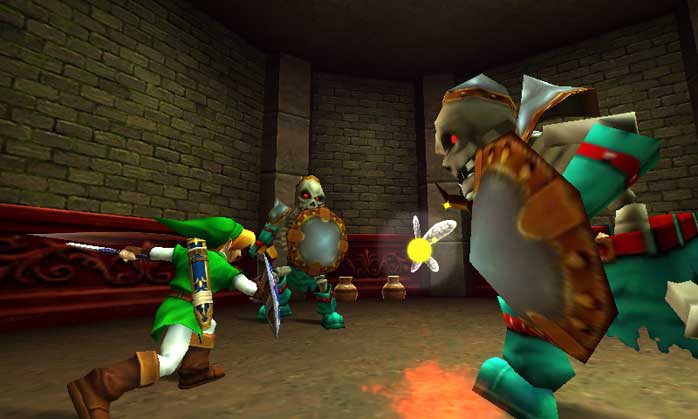
The two mazes Miyamoto let stay
Tap a temple to see why these two held onto the old linear design Miyamoto otherwise argued against.
That contradiction is part of why the upcoming remake carries weight for longtime players: it revisits dungeons that its own director once said didn’t fully belong in a 3D Zelda game. Nintendo’s official Direct recap confirmed the remake is heading to Switch 2 within 2026, though an exact release date has not yet been announced.
From fan remake to first-party remake
How a decade of community-built Ocarina of Time recreations led into Nintendo’s own announcement.
Why the fan remake actually closed
Two different reasons get assumed for fan-project shutdowns. Here’s which one applied.
No takedown notice was issued
CryZENx confirmed he did not receive a DMCA copyright strike from Nintendo. The closure was his own call, made ahead of the official remake’s announcement rather than in response to any legal action.
All of CryZENx’s earlier demo builds remain downloadable, and he has said a final video covering more gameplay chapters is planned as a send-off for the project. He is now running a community poll on his next retro remake target, with options including Twilight Princess, Donkey Kong 64, MDK, Turok, Metroid Prime Hunters, and Sonic Adventure. Readers tracking other community-built or anniversary projects in gaming can also see how existing live-service titles are expanding to new platforms through official beta programs rather than fan-made ports.
In short
The 1999 interview covered Miyamoto’s reasoning for moving Ocarina of Time away from traditional dungeon mazes, the two dungeons he named as exceptions, and the production strain the team faced while building them. The fan-made Unreal Engine 5 remake by CryZENx was discussed alongside this, including the timing of its closure relative to Nintendo’s official remake announcement and the absence of any copyright dispute between the two projects. Coverage of related franchise activity, including recent Overwatch season content and Cyberpunk 2077 merchandise news, was referenced for context on the broader gaming news cycle this period. The original GamesRadar+ report and Miyamoto interview translation can be found via the linked source below.